 Email: sales@jmchemi.com lisa@jmchemi.com
 Whatsapp: +8618953065520
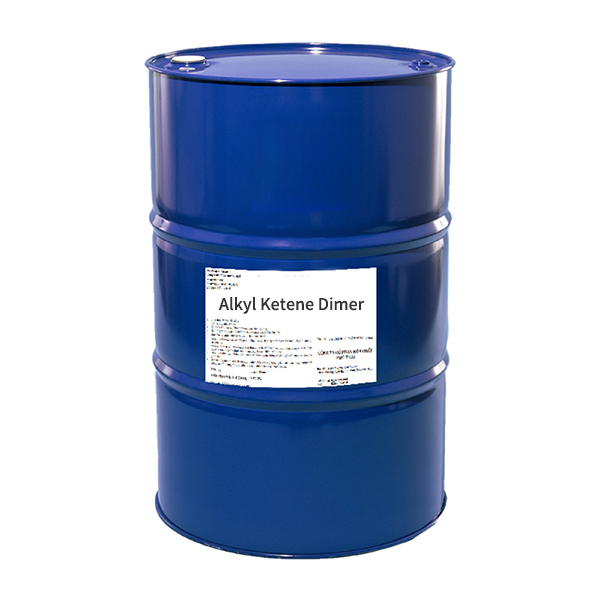
Technical Introduction
Alkyl Ketene Dimer (AKD) is a class of water-insoluble, wax-like organic compounds, recognized as a high-performance neutral sizing agent for the paper industry. With excellent hydrophobic modification capabilities, AKD is widely used to enhance the water resistance and printability of paper and paperboard, and it also serves as a functional additive in textiles and coatings.
1.Chemical Identity
| Item | Specification |
| Chemical Name | Alkyl Ketene Dimer; Diketene Alkyl Dimer |
| Abbreviation | AKD |
| General Molecular Formula | RCH=C=O-CHR-CO (wher R is a linear alkyl chain of C12–C18, typically C16–C18 for paper sizing applications) |
| Molecular Weight | 450–550 g/mol (varies with alkyl chain length) |
| CAS Registry Number | 7085-85-0 (generic for C₁₂–C₁₈ AKD) |
| UN Number | 3261 (Class 8: Corrosive Substances; subsidiary risk: Class 4.1 Flammable Solids) |
| Structural Feature | Contains two reactive ketene groups (-CH=C=O) linked by an alkyl bridge; the hydrophobic alkyl chain and reactive functional groups determine its sizing performance |
2.Physical & Chemical Properties
| Property | Industrial Grade Standard |
| Appearance | White to pale yellow waxy flakes, pellets, or powder |
| Melting Point | 40–60°C (optimal for papermaking: 45–55°C, matching C16–C18 alkyl chain) |
| Boiling Point | Decomposes above 150°C (breaks down into alkyl ketenes and fatty acids) |
| Density | 0.90–0.95 g/cm³ (solid state, 25°C) |
| Solubility | Insoluble in water; soluble in organic solvents (mineral oil, kerosene, toluene, xylene) |
| Flash Point | 180–200°C (closed cup) |
| Reactivity | Stable under dry conditions; hydrolyzes into fatty acids when exposed to water, acids, or bases; reacts with cellulose hydroxyl groups at 80–120°C to form covalent ester bonds (core sizing mechanism) |
| Storage Stability | 6–12 months (sealed, dry environment); prone to degradation if damp |
3.Industrial Synthesis Process
AKD is mass-produced via a two-step reaction using long-chain fatty acids as the core raw material:
Fatty Acid ChlorinationLong-chain fatty acids (C16–C18), e.g., palmitic acid, stearic acid) react with thionyl chloride (SOCl2) or phosphorus trichloride (PCl3) to generate fatty acid chlorides, with byproducts of sulfur dioxide and hydrogen chloride:RCOOH + SOCl2→ RCOCl +SO2↑+HCl↑ Dehydrochlorination & DimerizationFatty acid chlorides react with triethylamine (a dehydrochlorinating agent) to form intermediate alkyl ketenes, which undergo spontaneous dimerization to produce AKD. The byproduct triethylamine hydrochloride is removed via filtration and washing:2RCOCl + 2(C2H5)3N→RCH=C=O-CHR-CO + 2(C2H5)3N·HCl The crude AKD is further purified by distillation or recrystallization to obtain high-purity products in flakes or pellets.
4.Core Industrial Applications
AKD’s dominant application lies in papermaking, with extended uses in textiles and coatings:
Paper & Paperboard Sizing (Largest Application)
As a neutral-alkaline sizing agent, AKD is dispersed into water-based emulsions and added to pulp during papermaking. In the drying section, it reacts with cellulose hydroxyl groups to form irreversible covalent bonds, significantly improving paper’s water resistance, ink holdout, and printing adaptability. It is widely applied in offset printing paper, packaging paperboard, corrugated paper, and food-contact paper (compliant with FDA and EU food contact standards).Key advantages: Enables papermaking under neutral-alkaline conditions, reduces equipment corrosion, enhances paper strength, and increases filler retention rate.
Textile Industry
Used as a hydrophobic finishing agent for cotton, linen, and blended fabrics. It forms a thin hydrophobic film on fiber surfaces, improving water repellency and stain resistance without compromising fabric breathability.
Coatings & Adhesives
Serves as a crosslinking agent for water-based coatings and adhesives, enhancing film water resistance, adhesion strength, and chemical stability.
Other Uses
Additive in lubricating oils to improve anti-wear and anti-oxidation performance; raw material for synthetic waxes and specialty surfactants.
5.Safety, Health & Environmental Compliance
Health Hazards
Inhalation: AKD dust or vapor may cause mild respiratory irritation (coughing, throat discomfort); no systemic toxicity reported at normal industrial exposure levels.
Skin Contact: Mildly irritating to intact skin; prolonged contact may lead to dryness or erythema (wash with soap and water immediately).
Eye Contact: May cause transient eye irritation; flush eyes with plenty of water for 15 minutes if exposed.
Ingestion: Low acute toxicity; accidental ingestion may induce gastrointestinal discomfort (nausea, abdominal pain), but no severe poisoning symptoms.
GHS Classification: Skin Irritation (Category 2); Eye Irritation (Category 2); Flammable Solid (Category 4).
Environmental Impact
Biodegradability: AKD is readily biodegradable under aerobic conditions, decomposing into fatty acids and carbon dioxide without persistent accumulation in soil or water.
Aquatic Toxicity: Low toxicity to aquatic organisms (LC₅₀ for fish > 100 mg/L); safe for discharge after standard wastewater treatment.
Regulatory Compliance: Fully complies with EU REACH, US FDA 21 CFR, and China GB standards for food contact materials; no restrictions on industrial use.
6.Handling & Storage Precautions
Handling: Operate in a well-ventilated area to minimize dust exposure; wear a dust mask, safety goggles, and nitrile gloves during operation. Avoid contact with moisture, acids, or bases to prevent hydrolysis. When preparing AKD emulsions, heat the solid AKD to its melting point (45–55°C) under continuous stirring for uniform dispersion.
Storage: Store in a cool, dry warehouse (temperature < 30°C) with sealed containers (preferably plastic-lined to avoid moisture absorption). Separate from acids, bases, oxidants, and water. Shelf life: 12 months for solid AKD; 6 months for AKD emulsions.
Transport: Comply with UN 3261 transport regulations; use moisture-proof, sealed packaging. Avoid mixing with food, feed, or corrosive substances during transportation.