 Correo electrónico: sales@jmchemi.com lisa@jmchemi.com
 Whatsapp: +8618953065520
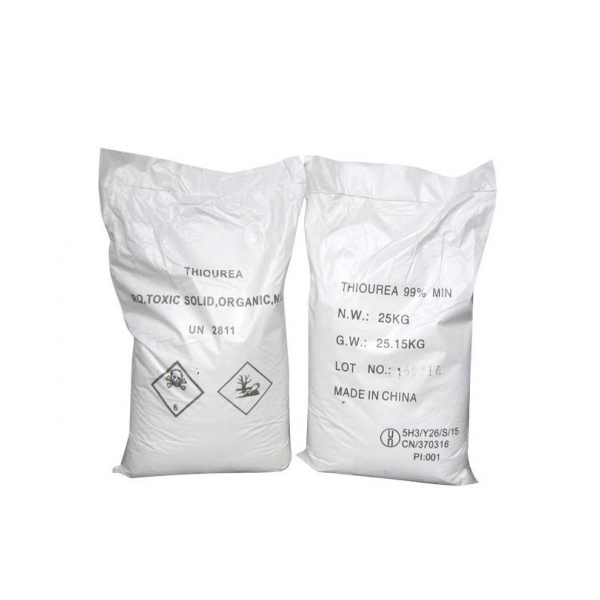
Technical Introduction
Thiourea is an organosulfur compound with a urea-like structure, where the oxygen atom is replaced by a sulfur atom. It is a white, crystalline powder with high solubility in water and polar organic solvents, and serves as a versatile intermediate in organic synthesis, metallurgy, pharmaceuticals, and analytical chemistry.
Chemical Identity
| Item | Technical Specification |
| Chemical Name | Thiourea; Thiocarbamide |
| Molecular Formula | CH4N2S |
| Peso molecular | 76.12 g/mol |
| CAS Registry Number | 62-56-6 |
| UN Number | 2811 (Class 6.1: Toxic Substances) |
| Structural Feature | Composed of a central carbon atom bonded to two amino groups (、(-NH2) and one thiocarbonyl group (-C=S); the polar structure enables strong hydrogen bonding and coordination with metal ions |
Core Industrial Applications
Thiourea’s unique chemical properties make it a key material across multiple sectors:
Metallurgical Industry (Largest Application)
Serves as a metal leaching agent and flotation reagent. It forms soluble complexes with precious metals (gold, silver, platinum), enabling efficient extraction of these metals from ores and recycled electronic waste. It is also used as a copper plating brightener to improve the smoothness and uniformity of electroplated layers.
Organic Synthesis Intermediate
Acts as a thiolation reagent for introducing sulfur-containing groups into organic molecules. It is a critical raw material for synthesizing pharmaceuticals (e.g., antithyroid drugs such as methimazole), pesticides (e.g., fungicides and herbicides), and dyes (e.g., sulfur dyes for textiles).
Analytical Chemistry
Used as a qualitative and quantitative analytical reagent for detecting heavy metal ions (e.g., Bi³⁺, Pb²⁺, Hg²⁺). It also serves as a reducing agent in redox titrations and a stabilizer for certain analytical instruments.
Other Uses
Textile Industry: As a reducing agent in vat dyeing and a shrink-proof finishing agent for wool fabrics.
Paper Industry: As a bleaching auxiliary for pulp to improve whiteness and reduce fiber damage.
Chemical Research: As a catalyst for organic reactions and a precursor for synthesizing heterocyclic compounds.
Transport: Comply with UN 2811 transport regulations; pack in sealed, leak-proof containers. Label packages clearly with “TOXIC SUBSTANCE” warnings. Avoid mixing with incompatible substances during transport.